


you have probably tried the free version of fitness already. Twelve saved reels, three abandoned apps, one gym membership that mostly funds the gym owner’s holidays, and a cousin who swears by eating only papaya after 6 pm. Information is not your problem. You could teach a short course on intermittent fasting by now. The problem is Tuesday at 9:40 pm, when the work call has finally ended, the fridge is humming at you, and nobody on Earth will notice if tonight’s walk becomes tomorrow’s walk.
That gap between knowing and doing is exactly where an online fitness coach earns their place. In 2026, remote coaching is no longer a pandemic workaround. It is a normal way for working adults in Chennai, Pune, Dubai or Toronto to get a trained person watching their progress without adding a commute to an already packed day. This guide explains what the role really involves, how it differs from trainers, apps and platforms, how it adapts to conditions like diabetes or menopause, and how to tell real coaching from a nicely designed PDF.
An online fitness coach is a trained professional who plans your workouts and nutrition remotely, then checks in regularly to adjust the plan and keep you accountable. It suits people who know roughly what to do but struggle to keep doing it, especially busy professionals and adults with health goals set by a doctor.
What an online fitness coach does and why it matters in 2026
An online fitness coach designs your training and eating around your actual life, then stays involved long enough to see what breaks and fix it. The plan is the easy part. The real work is the adjustment: noticing that your Monday workouts keep disappearing because of standing meetings, that your hunger spikes on days you sleep five hours, or that your weight has stalled while your waist keeps shrinking. A good coach reads those signals and changes the plan before you quit. This matters more in 2026 because the market is crowded with content and short on attention. Deloitte figures cited by Health & Fitness Association India estimate India’s fitness facility market at about INR 16,200 crore, with more than 46,500 centres and 12.3 million members. Plenty of people pay for access to equipment. Far fewer get someone who notices when they stop turning up. Coaching fills that second need: steady, informed attention over months instead of motivation over weekends.
That figure comes from the India Fitness Market Report 2025, and it reveals something odd. Millions of Indians already pay for fitness. Membership is clearly not the hard part. Staying with the process is.
Think of it this way. A gym sells you a room full of tools. An app sells you a set of instructions. An online fitness coach sells you a relationship with a person who knows your blood pressure readings, your travel schedule, your love of Saturday biryani and your knee that complains on stairs. Those details are where results either happen or die.
Coach, trainer, platform or app: sorting out the labels
These words get used as if they mean the same thing, and they really do not. A trainer mainly teaches and supervises exercise. A coach usually covers exercise, nutrition, sleep, stress and habits, and treats your behaviour as part of the job. A platform is a marketplace or software system that connects many coaches to many clients. An app is a tool for logging food, steps or workouts, sometimes with automated advice. In practice the lines blur. A trainer may give diet tips, and an app may hire coaches. The useful question is simple: who notices when you go off track, and what do they do about it? If the answer is a push notification, you have a tool. If it is a person who messages you with a smarter plan for your busy week, you have a coach. Knowing the difference saves you from paying coaching prices for app-level attention, or expecting app prices to buy human judgement.
Online fitness trainer and online gym trainer
An online fitness trainer focuses mostly on your workouts: exercise selection, sets, reps, form checks through video and progression over time. An online gym trainer is the same idea built around gym equipment, useful if you already have a membership and want structure instead of wandering between machines. Ask for form feedback on recorded sets. That single habit prevents a surprising number of injuries.
Personal fitness coach online
A personal fitness coach online works one-on-one with you and builds everything from your assessment. This is the most individual format. Your plan for a Bengaluru software lead who travels twice a month should look nothing like a plan for a Chennai teacher in perimenopause. If two clients receive identical programmes, the word personal is decoration.
Gym coaching and online fitness platforms
Gym coaching usually means in-person trainers at a facility, often sold in session packs. Online fitness platforms gather many coaches, programmes and tracking tools in one place, and they grew fast once India moved indoors. Adjust reported that health and fitness app downloads in India grew 156% quarter on quarter between Q1 and Q2 2020, the highest in the world. Downloads, though, are not the same as daily use, which is why human coaching still matters.
How online coaching works from week to week
Online coaching runs on a loop: assess, plan, act, check in, adjust, repeat. It starts with a detailed look at your history, goals, health reports and routine. The coach then builds training and nutrition that fit your real constraints, such as a 30-minute window before the school run or a canteen lunch you cannot control. You follow the plan and report back at agreed intervals, usually weekly. At each check-in the coach looks at numbers like body weight, waist measurement and step count, and also at biofeedback: sleep quality, energy, hunger, mood, digestion and recovery. Based on what they see, they change one or two things, not everything. That restraint is deliberate. When you change ten variables at once, you never learn which one worked. Over months, the plan becomes more yours and less generic, because every week adds data about how your body and your schedule actually behave. The loop matters more than any single workout.
The assessment
Expect questions that feel unrelated to fitness. What time do you wake up? Who cooks at home? How many times have you dieted before, and what happened afterwards? Do you eat more when work is stressful? These answers predict your obstacles better than your body weight does. A solid assessment also asks about medical conditions, medicines and recent blood reports, and respects your doctor’s advice.
The plan
Good plans are boring in a useful way. They usually include a few strength sessions a week, a daily movement target, enough protein spread across meals, and room for the foods you actually eat. Idli, poha, roti, sambar and the occasional office samosa can all fit. The plan should feel slightly easier than your enthusiasm suggests, because enthusiasm is loudest in week one and quietest in week six.
The check-in loop
Check-ins are where coaching earns its fee. A typical weekly check-in includes the following:
- Average body weight across the week, not a single morning reading
- Waist or other measurements every two to four weeks
- Sleep hours and how rested you feel on waking
- Energy, hunger and cravings, especially in the evening
- Training performance, such as heavier weights or more reps
- Digestion, stress levels and any pain or niggles
- One honest note about what got in the way
That last item is often the most valuable. “Had three client dinners” or “slept badly because of the baby” tells a coach what to adjust far more clearly than a number on a scale.
Why coaching works when willpower keeps failing
Coaching works because it moves effort away from willpower and towards systems, feedback and accountability. Willpower is a terrible strategy for a busy professional. It is strongest in the morning and weakest at night, which is exactly when most overeating happens. A coach reduces the number of decisions you need to make: what to eat for lunch, which workout to do, what to do when you miss a day. Fewer decisions mean less decision fatigue. Accountability adds a second effect. When you know someone will look at your week on Sunday, Wednesday’s choices feel different. This is not about guilt or fear of being scolded. It is the simple social pull of a commitment made to another person. Finally, feedback shortens the learning curve. Instead of guessing for six months why the scale is stuck, you get a specific answer in two weeks. For people who have regained weight after past diets, this cycle of small wins builds confidence that crash diets never could.
Here is an observation most people miss: the diets you failed did not fail because you were lazy. They failed because they had no plan for bad weeks. Every rigid diet works beautifully in a calm month. Then a deadline, a wedding or a sick parent arrives, the plan becomes impossible, and you drop it entirely. A coach designs a minimum version of your plan in advance. On a terrible week, you might only aim for 6,000 steps, protein at two meals and one short workout. Doing the minimum keeps the identity alive. You are still someone who trains, just on low power.
Emotional eating deserves its own mention. Stress eating is not a moral flaw. It is a learned way of calming down, and food works quickly, which is why the habit sticks. A coach does not simply ban the biscuits. They help you notice the pattern (same time, same trigger, same snack) and give you something else to do in that slot, such as a ten-minute walk, a proper dinner earlier in the evening, or a planned treat that removes the forbidden-food rush.
Systems beat motivation. Motivation is a mood, and moods change by the hour. A coach builds routines that survive low-energy days, so progress continues even when you do not feel like it.
Plan for bad weeks. Every client faces travel, illness and deadlines. A minimum plan agreed in advance stops one rough week from becoming a three-month break.
Feedback shortens guessing. Weekly data on sleep, hunger and measurements lets a coach find the real problem quickly, instead of you guessing alone for months.
Small changes compound. Getting 1% better at one habit each week sounds tiny. Over a year, those small changes add up to a different lifestyle without the burnout of extreme plans.

Coaching with a health condition after 35
For adults over 35 with hypertension, type 2 diabetes, thyroid issues, high cholesterol or menopause symptoms, an online fitness coach can be very useful, as long as the coach works alongside your doctor and never in place of one. Your doctor diagnoses, prescribes and monitors your condition. Your coach helps you carry out the lifestyle part of the advice, the bit that usually comes as one rushed line at the end of an appointment: lose some weight, walk more, eat better. Strength training, regular walking, better sleep and steady protein intake are widely supported for metabolic health, but the details need care. Someone on blood sugar medicine needs a plan that avoids long unplanned fasts. Someone with high blood pressure should learn to breathe steadily during lifts instead of holding their breath. A woman in perimenopause may need more focus on muscle, bone health and sleep. A good coach asks for your reports, tracks changes and refers you back to your doctor when something looks off.
If your doctor has asked you to lose weight, share your latest reports and medicine list with your coach at the start. Any change in medicine, new symptoms such as dizziness or chest discomfort, or very low sugar readings should go to your doctor first, not to your coach.
Menopause needs a special word because it is still poorly explained in many Indian households. Many women notice weight settling around the middle, poorer sleep, joint aches and mood changes, sometimes all at once. The usual response is to eat less and do more cardio, which can leave you hungrier, more tired and losing muscle. A more sensible approach puts resistance training first, keeps protein steady through the day and treats sleep as part of the plan, not an afterthought. Progress may look slower on the scale while clothes fit better and strength rises. Tracking those wins matters, because a scale-only view can make a working plan look like a failure.
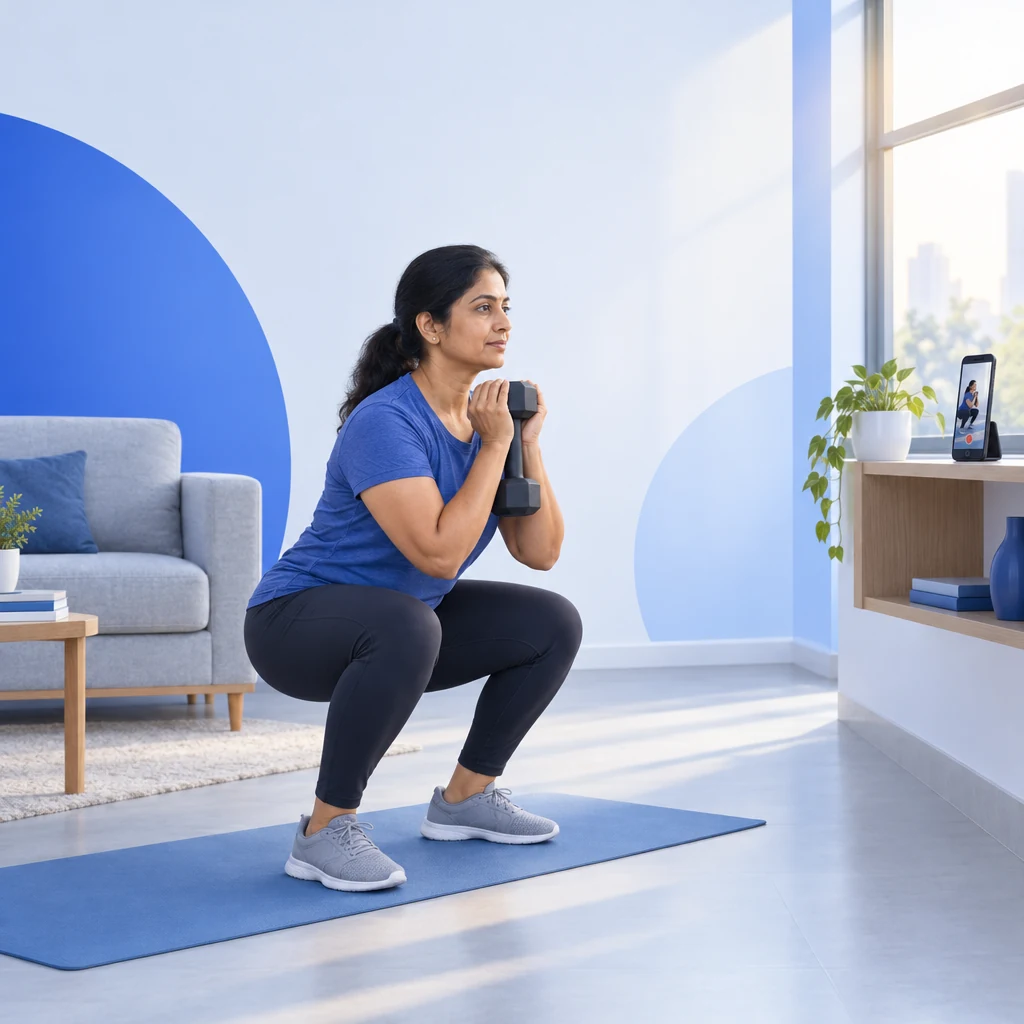
Age also changes the starting line. A 45-year-old who has not lifted anything heavier than a laptop bag needs a gentle on-ramp: bodyweight squats to a chair, wall push-ups, light dumbbells, and patience. Heavy, ego-driven lifting is how many late starters get injured and give up. Remote coaching handles this well because form videos and gradual progress can be checked every week.
Myths, red flags and signs of a good coach
The biggest myth about online coaching is that it is a cheaper, weaker version of in-person training. For most busy adults, the opposite can be true. An in-person trainer sees you for a few hours a week inside a gym. An online fitness coach sees your whole week: meals, sleep, stress and the late-night snack, which is where most weight problems actually live. The second myth is that a top-rated or famous coach must be the right coach. Follower counts measure attention, not fit. A coach who built their name on competition physiques may not understand a diabetic 50-year-old with a desk job. The third myth is that free plans online work just as well. Free plans can be a fine starting point, but they cannot adjust to you. The real test is how a coach responds when things go wrong, and you can usually learn that in a single honest consultation call before paying anything.
Signs you have found a good coach:
- They ask about your health history, medicines and reports before giving a plan
- Your nutrition plan includes foods you already eat and enjoy
- They track sleep, energy and hunger as well as the scale
- Changes happen gradually, one or two at a time
- They tell you clearly when something needs a doctor
- They explain the reasons behind your plan in plain language
Red flags worth walking away from:
- Guaranteed loss of a fixed number of kilos in a few weeks
- Detox teas, fat-burner pills or supplements sold as essential
- Diets that cut out whole food groups like rice or roti for everyone
- The same downloadable plan for every client
- No check-ins, or check-ins handled only by automated messages
- Shaming language about your body or past attempts
What about searching for a coach near you? With remote coaching, distance matters far less than understanding. A coach in another city who knows Indian food, work culture and family meals may suit you better than one around the corner. Apps are worth using as tools for tracking steps or food. India alone saw health app downloads rise 38% year on year between 2020 and 2021, reaching 76 million, according to Adjust. An app can log your life, but someone still has to read the log and decide what to change next.
Before you hire anyone, ask one question: what will you do if I miss a full week? A thoughtful answer about adjusting the plan tells you more about a coach than any transformation photo.
Frequently Asked Questions
These are the practical questions people ask most often before choosing an online fitness coach, from cost to training rules and courses. Prices and options change between cities and coaches, so treat each answer as a guide for what to ask about rather than a fixed quote. Where a figure matters to your budget, request it in writing during a consultation and confirm what is included, such as the number of check-ins, the type of feedback and how quickly the coach replies to messages. Clear terms upfront prevent disappointment later and help you compare like with like. If you have a medical condition, include your doctor in any decision about new training or major diet changes, especially if you take medicines for blood pressure or blood sugar. A good coach will welcome that step, ask to see your reports and adjust the plan around your doctor’s advice. If a coach dismisses it, take that as useful information about how they work.
How much does it cost for an online coach?
Cost varies widely in India depending on the coach’s experience, how often they check in and whether nutrition and training are both included. Group programmes and app plans usually cost less, while one-on-one coaching with weekly personal feedback costs more. Ask exactly what each check-in includes before comparing prices.
How much is a 1 hour PT session?
A one-hour in-person personal training session varies by city, gym and trainer experience, and metro rates are usually higher than smaller towns. Many gyms sell sessions in packs at a lower per-session rate. Compare that cost with monthly online coaching, which covers your whole week, not just one hour.
Can I find an online fitness coach for free?
Free content and guides are easy to find and can help you get started. Ongoing personal coaching, with a person reviewing your progress every week, is almost always paid because it takes real time. A consultation is a sensible way to test fit before you commit.
If you are tired of starting over every January, Qubit offers a consultation call to talk through your goals, health reports and schedule before any programme begins. We build flexible nutrition and strength plans around your real life, check in on sleep, energy and recovery as well as the scale, and help you get 1% better each week. Book the call, bring your questions (and your love of biryani), and see whether coaching with Qubit fits you.